




Executive Summary
The advancement of Singapore’s equity market and the launch of initiatives like Monetary Authority of Singapore’s (“MAS“) S$5 billion Equity Market Development Programme and MAS/Singapore Exchange’s (“SGX“) S$30 million Value Unlock Programme provide companies with valuable support to boost transparency and trust. The Value Unlock Programme helps listed companies enhance investor engagement and achieve fair valuation by addressing strategy and communication gaps. The evolving capital markets also means that investor confidence relies on clear forward-looking disclosures by listed issuers. This Update provides an overview of the Value Unlock Programme and explores Singapore Exchange Regulation’s (“SGX RegCo“) Regulator’s Column: Forward Guidance – Why It Matters and How to Get It Right which gives critical pointers on effective forward guidance. Please reach out to our Contact Partners to support your journey in unlocking your business’ full potential.
Value Unlock Programme
The Value Unlock Programme is a strategic initiative by SGX and MAS to help listed companies strengthen investor engagement and achieve fair market valuation, anchored on three pillars:
- Capabilities (building corporate strategy and investor relations skills);
- Communications (communicating strategic plans effectively and consistently); and
- Communities (connecting issuers and investors through platforms, such as Singapore Institute of Directors’ Chairpersons Guild).
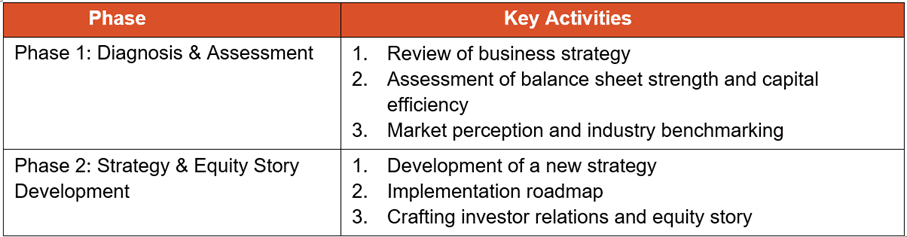
The unlocking strategy comprises two phases:
There are two grants (the Equip Grant and the Elevate Grant) under this programme.
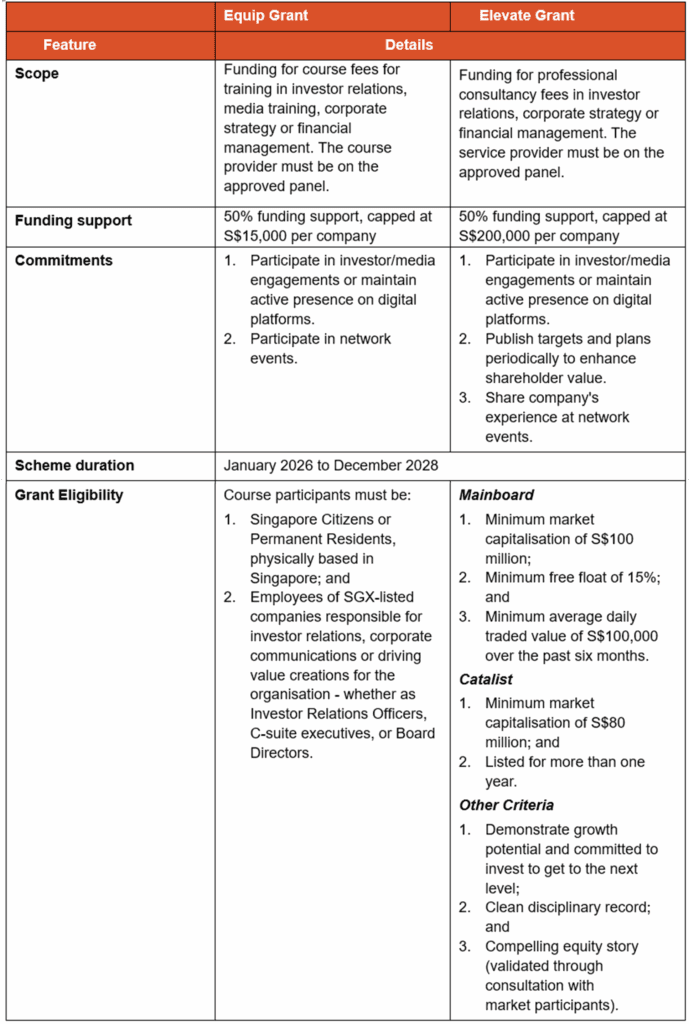
For information on the list of eligible courses and programmes and eligible companies who wish to participate in the Elevate Grant, please contact SGX at [email protected]. Service providers who are interested in joining the panel may also contact SGX at [email protected].
SGX RegCo’s Pointers on Forward Guidance
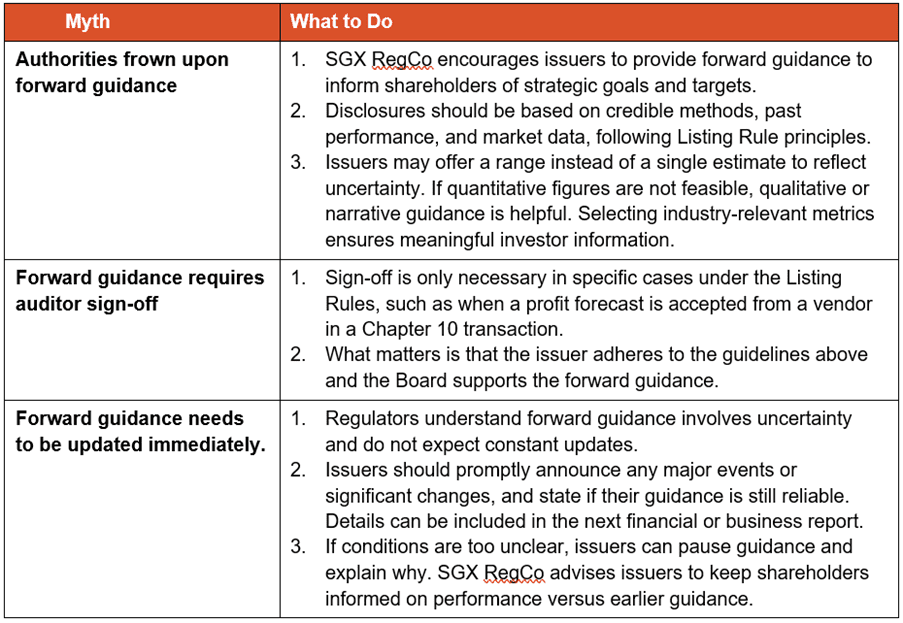
Forward-looking statements are commonly referred to as earnings or forward guidance. SGX RegCo has clarified three biggest myths on forward guidance, as summarised below:
Three Key Points
- Issuer is ultimately responsible for the accuracy and integrity of their announcements, including forward guidance. Issuers must disclose all material information, including forward-looking statements, via SGXNet.
- Understanding Uncertainty: Investors should recognise that forward guidance inherently pertains to an uncertain future. It is unreasonable to expect issuers to fulfil their projections with absolute certainty.
- SGX RegCo adopts sensible regulatory oversight when reviewing compliance with the Listing Rules. Forward-looking disclosures made in good faith, with adequate explanations of the basis and uncertainties involved, generally will not trigger regulatory queries.
SGX RegCo supports disclosures that foster transparency and informed decision-making. Forward guidance is not merely a compliance requirement, but a tool for competitive advantage.
If you have any queries on the above, please reach out to our Contacts or KM at [email protected].


